How To Hold People Accountable Without Shame

Dr. Nika White • July 20, 2021

We know holding folks accountable for saying or doing harmful things is important to DEI. Without the checks and balances system, where would we be? But I’ve noticed a trend in how we approach folks we’re calling in: people are using shame as a tool to get folks to admit wrongdoing. Shame isn’t the best way to hold someone accountable or get them to change their behaviors. I recently wrote a tweet about this very topic:
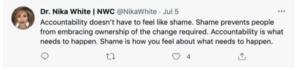
Here’s what we all need to understand: Holding someone accountable doesn’t require shame. Actually, there are real and tangible ways you can have an honest and effective conversation with someone without them retreating into shame, anger, and defensiveness.

Here’s how you can hold people accountable without using shame. And if you’re the one being called in, here’s how you can take constructive feedback with openness instead of defensiveness.

Understand that people may not know they’ve caused harm to others

The truth is many people say and do harmful things, and they may not know they’ve done something wrong.

It’s important to understand that harm is inevitable because people are often operating unconsciously. In other words, folks are on autopilot when it comes to their speech and behavior and what comes out of their mouths may not seem harmful to them. But as it turns out, what they did or said was very harmful and someone else has to check them on it.

The key to beginning the process of holding someone accountable is to move with empathy. Both people should understand that making mistakes is a part of being human. And both parties should also move mindfully through these conversations. Here’s how you do that.

If you’re being called in or held accountable, know that you’re not the victim.

Once someone has been called in and both parties are aware of the problem, the mindset should be: “What will my response be now that I’m aware?

Getting called in can make some people defensive, fearful, or feel that others are gaslighting them. In essence, we, as people being called in, become the victims. But we have to realize, no we’re not the victims. The person who is holding us accountable is sharing this issue with us because there needs to be a change in order to reach equity, inclusion, and compassion. There’s no shame in admitting that we’ve brought harm to someone else and that it wasn’t right. But, it’s important to adapt to the feedback we’re receiving and integrate it.

If you’ve been called out, the questions you should ask yourself are:

  • What harm was caused?
  • What does that mean?
  • What was the impact?
  • What are the needs of the person who was harmed?

Having empathy for yourself and understanding that biases occur within all of us is another key step. We can’t avoid it. Acknowledging that harm has been done is crucial. When an issue is brought to our attention, what we need to do is think about how that harm has created negative consequences for the other person, the person who’s really the victim. So, we should ask ourselves: what do the people we harmed need at this moment?

Don’t fall into the trap of feeling rushed to be forgiven by the person who called you out. Sometimes your actions or words were so harmful that people aren’t ready to forgive yet. So, give people their space and respect the time it takes to circle back and begin the process of forgiveness.

If you’re the one being held accountable, it’s important you take responsibility and make sure no future harm is created. Apologize, feel atonement, and acknowledge the harm, but commit to not continuing the cycle.

And most importantly, don’t do this work alone. Seek reassurance and support from people who are there for you. Connect with your community and talk out what happened. Ask if they’ve been through the same thing or how they’ve handled it. Seek to understand, reflect, and course-correct. But don’t shame yourself for what you didn’t know. Now, you know, so you can make better choices in the future and that’s what really matters.

If you’re holding someone accountable, your job is not to shame them. It’s to inspire behavior change.

It’s not easy to call someone in with respect and kindness, but it’s necessary in this work. Many people feel ashamed at the moment and can react poorly to being called out. But it’s important for you to practice empathy and self-control in moments like this because the ultimate goal is to encourage a change in behavior. However, shaming the person or reciprocating vengeful words and actions in the interaction is not the way to do it.

First, if you want to hold someone accountable and to be effective, it’s best to focus on the behavior or action, NOT the person. This is important because a lot of people react to being called in as a defect in their character or personality. But it’s not. They’re not the problem. The problem was their words or actions, which can be changed. When you’re calling someone in, focus on what was said or done and how those actions created the issue. Create a separation between the person’s actions and their inherent value as a human.

The reality is some people aren’t culturally competent and may not have the language to respectfully move in certain spaces. It’s a fact that hurt people hurt people. Underneath oppressive remarks, slurs, and comments is, oftentimes, someone acting from a place of hurt. Having empathy for a person that’s hurting doesn’t make what they said or did right, but it does show us a path forward to responding, and it opens us up to being more thoughtful about our approach to behavioral change.

When holding someone accountable, it’s also important to understand the difference between responding and reacting. Reacting means having no thought of the long-term consequences of an action. Responding means being more mindful about effective strategies to increase the likelihood of behavior change.

In the case of calling someone in and holding them accountable, we want to respond, not react. We want to make it clear what was said or done was harmful and here’s why. Reacting with anger, shame, or resentment will likely increase the temperature in the room and encourage defensiveness in the receiving party. Which is helpful for no one and won’t improve the situation.

Helpful phrases to use when holding someone accountable:

So, if you’re ready to have the hard conversation with someone in a respectful and effective way, here are a few phrases you can use to open up the conversation:

  • “Tell me more about the way you’re thinking.”
  • “Help me to understand your perspective.”
  • “What caused you to feel that way?”
  • “What do you mean by that?”
  • “That’s not a part of our culture.”
  • “That’s not okay with me and I respect you enough to let you know.”
  • “Have you considered the harm your words and behaviors can have on others?”
  • “I’m telling you this because I believe on the issue of bias, we can all learn. It takes a brave spirit for someone to bring forth that constructive feedback.”

Final Thoughts

This isn’t the first and probably won’t be the last time you’ll have an intentional conversation about hurtful words or behaviors. But this can be the first time that the conversation is effective. Again, the goal is to change behavior and to influence another person to reflect on their words and actions in order to course-correct. The more we can remove the barriers of shame and fear, and step into the arena of conversation, enlightenment, and mutual respect, the better our odds are of creating more equity, inclusion, and connection in our relationships with others.

Read more from The Human Shift on Substack, where I share long-form essays on leadership, culture, and how we work and live.

Share this Content:

By Nika White June 1, 2026
Disconnection rarely happens all at once. It builds slowly. A conversation you rush through. A moment you don’t fully listen. A tension you move past instead of addressing. Over time, these moments accumulate. Earlier in The Human Shift, Inclusion Isn’t Exhausting – Disconnection Is , we explored inclusion as lived experience. Disconnection is often not intentional—it is the result of repeated missed moments of connection. A Reframe Disconnection is not a single event. It is a pattern of small moments. One Simple Practice Today, in one conversation, slow down enough to fully listen—without preparing your response. Just notice. Question To Consider Where have small moments of disconnection quietly added up? What This Looks Like In Practice In culture work, repairing disconnection rarely requires large interventions. It requires consistent attention to everyday interactions. In the shift, Dr. Nika White P.S. When was the last time you felt fully present in a conversation?
By Nika White May 27, 2026
In high-performing environments, leaders often feel the need to demonstrate value constantly. Speaking. Solving. Contributing. But not all leadership is visible. Sometimes the most impactful presence is quiet. Earlier in The Human Shift, The Shift From Bracing to Grounding , we explored grounding as staying connected to yourself in the moment. Presence allows leaders to influence without constant action. A Reframe Leadership is not always what you do. Sometimes it is how you are. One Simple Practice In your next meeting, contribute one fewer time than you normally would. Instead, observe: What changes when you create more space? Question To Consider What would shift if you trusted your presence as much as your output? What This Looks Like In Practice Leaders who learn to use presence intentionally often find their influence increases—not decreases—while their effort becomes more sustainable. In the shift, Dr. Nika White P.S. Where might doing less actually strengthen your leadership today?
By Nika White May 19, 2026
Not all expectations are stated. Some are felt. You feel them in how quickly you respond. In how prepared you need to be. In how little room there seems to be for uncertainty. These expectations shape behavior—even when no one has said them out loud. Earlier in The Human Shift, Culture is What People Carry Home, we explored how culture is what people absorb. Unspoken expectations are one of the most powerful ways culture is transmitted. A Reframe What is unspoken is often what is most influential. One Simple Practice Ask yourself: “What expectations am I operating under that no one has actually confirmed?” Then question one of them. Question to Consider What might change if you clarified one assumption you’ve been carrying? What This Looks Like In Practice In organizational work, many performance patterns are driven less by formal expectations and more by perceived ones. Naming them creates immediate relief and clarity . In the shift, Dr. Nika White P.S. What expectation are you currently meeting that may not actually exist?
By Nika White May 11, 2026
Speed often feels like progress. Decisions made. Meetings closed. Momentum maintained. But speed and clarity are not the same. Earlier in The Human Shift, The Cost of Constant Readiness, we explored how readiness can create urgency where it may not actually exist. When leaders move quickly from that state, decisions can reflect pressure more than perspective. A Reframe Speed moves things forward. Clarity moves things well. One Simple Practice Before your next decision, ask: “Am I choosing speed—or am I choosing clarity?” If it’s speed, ask: “What would clarity require right now?” Question to Consider Where might slowing down actually create stronger outcomes? What This Looks Like In Practice Many organizations don’t suffer from slow decision-making—they suffer from fast decisions that require correction. Clarity reduces rework.. In the shift, Dr. Nika White P.S. What decision today would benefit from just a little more space?
By Nika White May 4, 2026
High-capacity leade rs often say: “I’ll take care of it.” At first, it’s situational. Then it becomes habitual. Eventually, it becomes identity. You’re the one who handles things. The one people trust. The one who doesn’t drop anything. But identity-level responsibility is different. It doesn’t turn off. Earlier in The Human Shift, Capacity is not Infinite, we explored capacity as information. When responsibility becomes identity, capacity signals are often overridden—not because leaders don’t feel them, but because they don’t believe they can respond to them. A Reframe Responsibility is a role you hold. Not a definition you carry. One Simple Practice Today, notice one “yes” you give automatically. Pause. Then ask: “If I didn’t see this as mine by default, what would I choose?” Question To Consider Where has your sense of responsibility expanded beyond what is actually yours? What This Looks Like In Practice In leadership development work, one of the most important shifts is helping leaders separate identity from role. When that happens, both performance and sustainability improve. In the shift, Dr. Nika White P.S. What responsibility do you carry right now that no one explicitly asked you to hold?
By Nika White April 27, 2026
Some leaders become known as “the calm one.” The one who steadies the room. Who doesn’t react. Who absorbs tension without showing it. It’s a valuable presence. But over time, it can quietly become a role you feel responsible to maintain. Not because it’s always needed. But because it’s expected. Earlier in The Human Shift, The Shift from Bracing to Grounding , we explored how leaders often move into bracing without realizing it. Being “the calm one” can sometimes be a more refined version of the same pattern—holding steady externally while managing pressure internally. A Reframe Calm is not a performance. It is a state that requires support. One Simple Practice Notice one moment today where you feel responsible for stabilizing others. Instead of immediately holding that role, pause and ask: “Is steadiness needed here—or am I used to providing it?” Question to Consider Where has your composure become something you feel you must maintain rather than something you can access? What This Looks Like In Practice Many leaders I work with don’t struggle with composure—they struggle with the cost of sustaining it alone. When shared steadiness becomes possible, leadership begins to feel lighter. In the shift, Dr. Nika White P.S. Where in your leadership do you feel most responsible for “holding the room”?
By Nika White April 20, 2026
Some leaders repeat directions often. Others rarely need to.  The difference is not position. It is trust in their steadiness. Authority rooted in pressure requires monitoring. Authority rooted in presence requires less reinforcement. This connects back to grounding, in The Human Shift, The Body Knows Before the Mind Does. When leaders are regulated, direction travels clearly without amplification. Reframe Authority is not measured by force. It is measured by reliability. One Grounded Practice Before giving direction, slow your speaking pace by 10%. Then deliver the message once, clearly and calmly. Consistency communicates confidence more than volume does. Closing Reflection Do people follow your direction because they understand — or because they feel urgency? Contextual Depth Signal Leaders who cultivate a steady presence often find they need fewer reminders, corrections, and escalations. Regulation reduces management load. In the shift, Dr. Nika White P.S. When you give direction, what do you think your team experiences — clarity or pressure?
By Nika White April 13, 2026
Leaders often focus on how meetings go. But the greater influence is what happens afterward. What people replay during their commute. What they describe at dinner. What they anticipate the next morning. Leadership is remembered less for exact wording and more for internal experience. Earlier, in The Human Shift, Culture Is What People Carry Home, we discussed how the emotional residue of leadership interactions shapes engagement more than policies do. Reframe Leadership influence continues after the conversation ends. One Grounded Practice After a meeting, pause for one minute and ask: “If I were in that conversation as a participant, how would I feel right now?” Not how you intended. How it likely landed. Closing Reflection What emotional tone do your interactions leave behind? Contextual Depth Signal Organizations often attempt culture change through communication strategies, but emotional experience — not mes saging — is what employees actually carry. In the shift, Dr. Nika White P.S. After a typical meeting with you, what do you think people feel most — clarity, pressure, or steadiness?
By Nika White April 6, 2026
Leaders often believe transparency exists because information is available. But culture is revealed by what people choose to share — not what they’re allowed to share. When teams withhold concerns, it rarely begins with fear. It begins with small experiences: Ideas redirected quickly Mistakes met with visible tension Questions answered defensively Over time, people learn which conversations require self-protection. Earlier, in The Human Shift, Culture Is What People Carry Home, we explored culture as what people absorb. Silence is one of the clearest indicators of that absorption. Reframe Candor depends less on policies and more on predictability of response. One Grounded Practice In your next meeting, when someone raises a concern, respond first with: “Tell me more.” Do not correct immediately. Do not solve immediately. Signal curiosity before direction. Closing Reflection What information seems to reach you last? Contextual Depth Signal Many culture initiatives fail not because values are unclear, but because reactions teach people which truths are welcome. In the shift, Dr. Nika White P.S. If someone on your team hesitates before speaking, what do you think they’re predicting?
By Nika White March 30, 2026
Not all fast decisions are strategic. Some are relief. Ambiguity produces tension. A quick decision restores certainty — even if it doesn’t improve outcomes. Leaders often experience resolution as progress. But clarity and certainty are not the same. Earlier in The Human Shift, The Stories We Tell Under Pressure , grounding was described as remaining present under pressure. Many leadership decisions improve when leaders stay with uncertainty slightly longer than feels comfortable. Reframe A quick decision reduces discomfort. A clear decision reduces rework. One Grounded Practice When faced with a non-urgent decision, ask: “What additional information might emerge if I waited 24 hours?” Then actually wait. Not to avoid responsibility. To allow discernment to complete. Closing Reflection Where in your work might patience increase effectiveness? Contextual Depth Signal In advisory settings, leaders often discover that many operational “fires” were created by premature decisions rather than delayed ones. In the shift, Dr. Nika White P.S. Which decision right now feels pressing — and what would happen if you gave it one more day?